
A question I’ve puzzled over since my first year at university. A compelling question that I think I’ve always know the answer to. At first glance, you might be tempted to say that of course the world is designed for women, just look at all the products and services that are provided for them. However, if you take a closer look, you will find many designs still use the male body as the default with women being an afterthought.
One of the first things that comes to mind for me when asking if the world has been designed for me is in automotive safety.
Did you know that crash test dummies were modelled for the average male and that it was 2003 before the first ‘female’ crash dummy was introduced? I used quotation marks around female as this dummy was just a scaled down version of the male one.
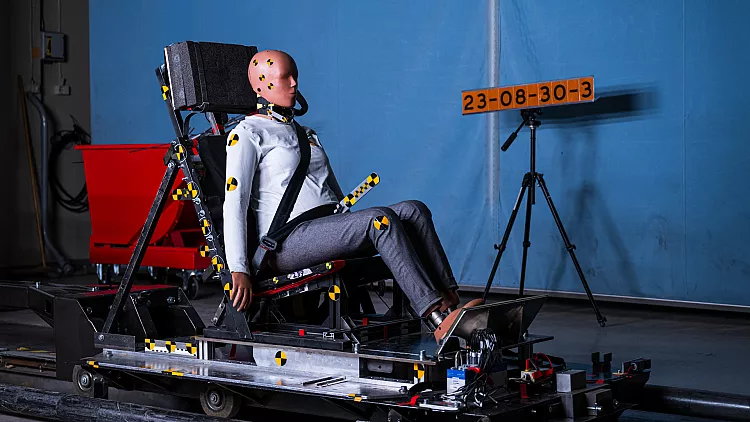
It has taken until 2023 before the first crash dummy with proper female proportions was used in automotive testing. And to make matters worse, women are more likely to be seriously injured or die in a car accident than men.
But this isn’t only only time women have been excluded in the testing. In medical research, they often don’t use female animals during drug testing. Why? Because their hormone mess with the results. The same reason why they previously didn’t include women in human clinical trials!
But wait, it can all be bad. Gender neutral design exist. I think this term is misleading, gender neutral isn’t a thing rather its just using the male as the default. Gender neutral clothing is just men’s fit disguised behind words. Speaking of gender neutral, the first public toilets in the UK were for men. A bodily function that everyone does and women were not included. It’s not because there were only urinals, flush toilets existed and were in the men’s toilets but rather due to the perception that women shouldn’t exist in the public sphere. It’s not hard to connect the dots. The lack of women considered design almost certainly comes from historic, misogynistic views.
But this is an historic example, so lets talk about phones or smart watches or hand tools or even surgical equipment. They are all too big for the female hand and wrist because ergonomic studies used to create them all tend to be based on male anthropometrics. Why is this so bad? Because men have bigger hands, stronger grip, tend to be taller and have a different body shape. In first year, when being taught to draw a human figure, I was taught how to draw a man but wasn’t taught to draw a female. In an engineering degree centred on designing for a user, are we already teaching them that women’s bodies don’t matter when it comes to design?
I’ve been reading Invisible Women by Caroline Criado Perez over the Christmas break. Throughout the book, I found myself getting angry that so much of the world had such little consideration of women. When faced with so many examples where women have been let down and it often leading to increased health risks or even increased mortality, I just felt like this issue was so systemic there was nothing I could do about it. But there is, as a future engineer, I am going to be in the room and should be able make an impact on these designs.
Change is happening and, in recent years, there has been a growing recognition of women’s needs. Athletic companies like Nike and Adidas now produce running shoes, sports bras and other performance apparel which has been engineered using female biomechanics. This is allowing these designs to account for the differences in support and cushioning needs and the differences in flexibility, starting to revolutionise female comfort and performance in sport. Similarly, the smartphone market now offers “compact” models crafted to fit smaller hands. These cases demonstrate that when designers actively seek out and incorporate gender-specific data, the outcome can be products that not only fit women better but also elevate the experience for all users.
So how can we as designers be truly inclusive?
We need to start moving away from “one size fits all” assumptions and integrate detailed, gender-disaggregated research. We can do this by using diverse data from comprehensive anthropometric studies which include characteristics, dimensions and abilities of all genders. We should also be using a diverse range of users to test products during iterative prototyping and adjusting based on feedback. This also involves actively seeking out instances where current assumptions may favour one group over the other and not discarding the data from groups that don’t fit our design. We also cannot afford to be afraid to challenge current norms and assumptions. We should be adopting universal design principles that aim to accommodate diverse user profiles.
Only by rigorously applying these principles can we as designers can avoid the pitfalls of historical bias and deliver products and environments that truly work for everyone. As designers and engineers, every design choice should be informed by the rich tapestry that is human experience and adopt the no one left behind mentality into our designs.
I believe we need to continue this dialogue in the design environment and push the boundaries of what it means to design for all.
 RGE Design
Leave a comment